If you are commissioning a sign language interpreter video in Lebanon, the decisions that matter come early: which sign language the audience uses, how the interpreter will appear on screen, and who checks the result. Get those three right in the brief and the shoot is straightforward. Get them wrong and the video may have to be redone.
We are Fine Line Production, a production house in Hamra, Beirut. Sign language integration is one of our services, with interpreters for Lebanese, Jordanian and Palestinian sign languages. This guide is about commissioning: what to ask for and what to check. For the wider case for accessible video, see our guide to sign language and accessibility in Arabic video.
Which sign language does your audience use?
Start here, because it decides who you hire. The United Nations notes that deaf people worldwide use more than 300 different sign languages, and describes them as fully fledged natural languages, structurally distinct from spoken languages. A sign language is not Arabic signed word for word, so an interpreter is matched to the audience, not just to the script.
In practice, say who will watch. A video for deaf viewers in Lebanon calls for a Lebanese sign language interpreter. One meant for Jordan or Palestine needs an interpreter for that country's sign language. If a video has to reach several countries, say so in the brief and plan a version for each, the same way you would plan Arabic and English versions. Our services page lists the three sign languages our interpreters cover.
Where should the interpreter appear on screen?
This is the choice that most changes how the video looks. The World Federation of the Deaf and the World Association of Sign Language Interpreters published guidelines on sign language access to public health information in March 2020. They were written for pandemic information, but the screen advice is a useful reference for any informational video. For a studio news broadcast they describe two layouts:
- Preferred: the interpreter placed on screen using chroma key (green screen), with the interpreter inset at least half of the screen.
- Alternative: the interpreter in a box filling 25% of the screen, separate from the main image.
For national press conferences and emergency broadcasts, the same guidelines ask for the interpreter to be displayed in the full screen image at all times, with no text or graphics covering the interpreter. The practical lesson for a brief: ask for a size, write it down, and keep lower thirds and logos out of the interpreter's area. Agree the interpreter's size in writing before the shoot.
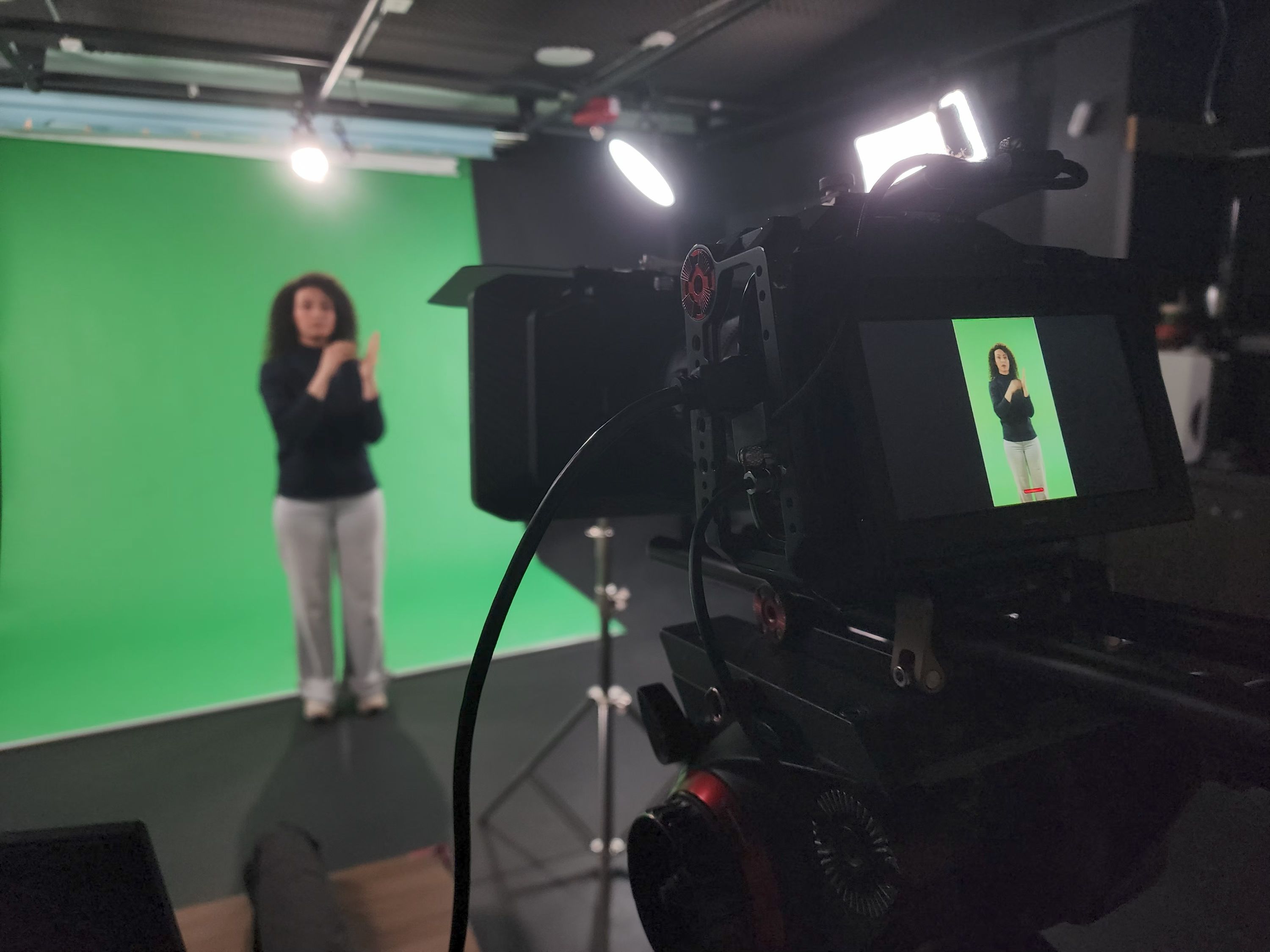
Chroma key is also why a studio shoot makes sense. We film interpreters against a green screen at our Hamra studio, and we build the interpretation into the production from the start rather than adding it at the end, so the layout is designed rather than pasted on. See the studio film page for the space.
How does a sign language interpreter video get made?
The sequence is simple, and each step has an owner. This is how we would plan it:
- Step 1, brief. Audience, sign language, screen layout, the language of the spoken track and any captions.
- Step 2, script handover. Send the interpreter the final script, names, acronyms and technical terms before the shoot day, not on it. A script that changes after the interpretation is filmed means filming the interpretation again.
- Step 3, main film. The film is edited first or in parallel, so the interpreter can follow the real timing of the speaker.
- Step 4, interpreter shoot. The interpreter is filmed against green screen, lit cleanly so the hands and face read clearly.
- Step 5, composite and review. The interpreter is placed in the frame at the agreed size, then the result is reviewed (see the next section).
- Step 6, delivery. Final files, with each version named clearly.
This runs more smoothly when one team handles the film, the studio session and the edit. That is the point our corporate video cost guide makes about one team instead of a chain of suppliers.
Who checks the interpretation before it is published?
Ask for a review by a deaf reviewer who uses the target sign language, not only by the production team. The WFD and WASLI guidelines say that professional interpreters with national-level qualifications should be hired, and that national deaf associations should be contacted for their expertise and guidance in developing such videos. For videos created in sign language, they name a deaf presenter as best practice, so the information comes from a native user of the language.
For a commissioner this turns into three questions to put in the brief: who interprets, who reviews, and how many rounds of corrections the quote includes. Plan the review before the composite is locked, because changes after the edit is final cost more.
Do captions replace a sign language interpreter?
No. They serve different viewers. The same guidelines recommend that videos in sign language also be subtitled in the country's national language or languages, so captions sit alongside the interpreter and do not substitute for one.
Plan them as part of the package: Arabic, English or both, depending on your audience. When the Embassy of Canada commissioned I Am Strong, the film was delivered in English, French and Arabic versions. Decide the versions early, so each one is planned before the edit.
What affects the cost of adding a sign language interpreter?
We do not publish a price list, and this guide will not invent one. What we can show is what shapes a quote:
- Number of sign languages. Each language is its own interpreter and its own version.
- Running time. Longer films mean longer interpreter sessions.
- Screen layout. A large composited interpreter takes more design and edit time than a plain box.
- Script stability. Late script changes mean filming the interpreter again.
- Review rounds. A deaf reviewer and a correction round are work, and belong in the quote.
- Planned versus retrofitted. Building it in from the start is one production step. Adding it to a finished film is rework.
For the general logic of how a video budget is built, read how much a corporate video costs in Lebanon. To write a brief that gets an accurate answer, our NGO video brief template is a good starting point.
Why accessibility belongs in the brief
Article 21 of the UN Convention on the Rights of Persons with Disabilities asks states to accept and facilitate the use of sign languages in official interactions and to encourage the mass media, including providers of information through the Internet, to make their services accessible. For NGOs, agencies and companies, that is a reason to treat access as part of the film and not an extra. The UN also counts more than 70 million deaf people worldwide, a figure it attributes to the World Federation of the Deaf.
If you are working on humanitarian or institutional films, see how we plan them in how humanitarian films get made and browse our impact videos. When you compare producers, our guide to choosing a video production company in Lebanon lists what to ask.
If you have a video that needs an interpreter, send us the audience, the sign language and the running time. Email info@finelineprod.com, call +961 1 741 744, or use the contact page.