When people hear "accessible video", they often picture a small optional extra for a small audience. Both halves of that picture are wrong. The audience is enormous, and accessibility is not an extra you sprinkle on a finished film; it is a production decision that changes how the film is designed from the start.
We are Fine Line Production in Beirut. Sign language integration is one of our standing services, with interpreters for Lebanese, Jordanian and Palestinian sign languages, and this article explains what video accessibility actually involves: who it serves, how it is produced, and what to ask for when you commission it.
The audience is not small
The World Health Organization's deafness and hearing loss fact sheet counts over 5% of the world's population, 430 million people, requiring rehabilitation for disabling hearing loss, and projects that by 2050 over 700 million people, 1 in every 10, will have disabling hearing loss. Among them, the United Nations cites the World Federation of the Deaf: more than 70 million deaf people worldwide, more than 80% of them living in developing countries, using more than 300 different sign languages.
That last number carries the point most people miss.
Sign languages are languages, plural
There is no single universal sign language. The UN counts more than 300 in use, and they are full languages, not gestured translations of spoken ones. That matters directly in our region: Lebanese, Jordanian and Palestinian sign languages are distinct, which is why our interpretation service is built around interpreters fluent across those three, matched to where the film's audience actually is. An NGO publishing a video for audiences in Beirut and Amman is publishing into two sign languages, the same way it would think about Arabic and English.
How sign language actually gets into a video
The honest answer: properly, or badly. The badly version is familiar, a finished film sent out with a tiny interpreter box squeezed into a corner as an afterthought.
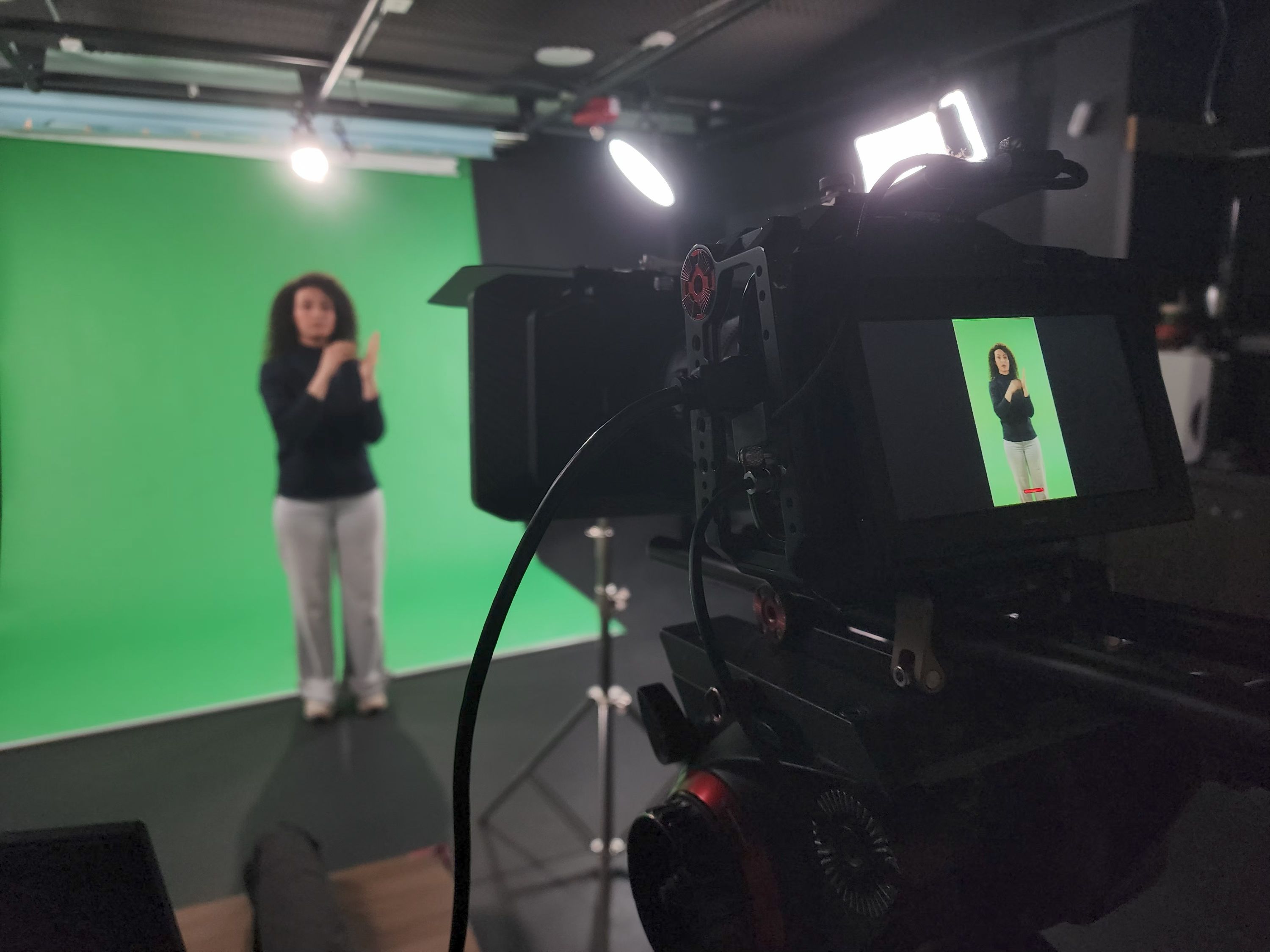
Building it properly means deciding at the start that the film will carry an interpreter, and designing for it. We build sign language integration into the production from the beginning rather than adding it at the end: the interpreter is filmed cleanly against green screen, the frame is composed so the interpreter has real space without covering the action, and the edit treats the interpretation as part of the film's design rather than a patch on top of it. This is also simply cheaper: planned integration is one production step; retrofitting a finished film is rework.
Captions are for everyone
Captions serve deaf and hard of hearing viewers first, and then everyone else: people watching with the sound off on a phone, people watching in a second language, people in loud rooms. On our own projects, subtitling runs in both directions between Arabic and English, and versions are planned before the edit so the pacing accommodates reading.
Full multilingual versioning goes a step further than subtitles. When the Embassy of Canada commissioned I Am Strong, a documentary about the resilience of Lebanese women after the 2024 war, the film was delivered in English, French and Arabic versions, each carrying the same first-person structure to a different audience. Accessibility and reach are the same production discipline: deciding early who needs to receive the film, and building every version to the same standard.
The context in Lebanon
Lebanon has had disability rights legislation for a quarter century: Law 220/2000 on the rights of persons with disabilities, passed in May 2000, covering education, employment, accessibility and services. For organizations working here, international funders increasingly expect accessible communications as a matter of policy, and for UN agencies and NGOs, an inaccessible film about inclusion is a contradiction the audience notices. Our client base leans heavily toward exactly those organizations, so interpretation, captions and multilingual delivery are regular parts of our production planning rather than exotic requests. You can see the service described on our services page, and the wider documentary context on our impact videos page.
What to ask for when you commission a video
- Decide the languages first, spoken and signed, based on where the film will be seen. This shapes the schedule and the frame, so it belongs in the brief, not the delivery email.
- Ask how the interpreter will be integrated. "Filmed against green screen and composed into the frame" is the answer you want to hear; "we will add a box in the corner" is not.
- Plan captions as versions, Arabic and English as needed, and ask for the caption files themselves so platforms can use them natively.
- Ask for the master to be versioned, so future languages can be added without re-editing the film.
Email info@finelineprod.com, call +961 1 741 744, or use the contact page.