
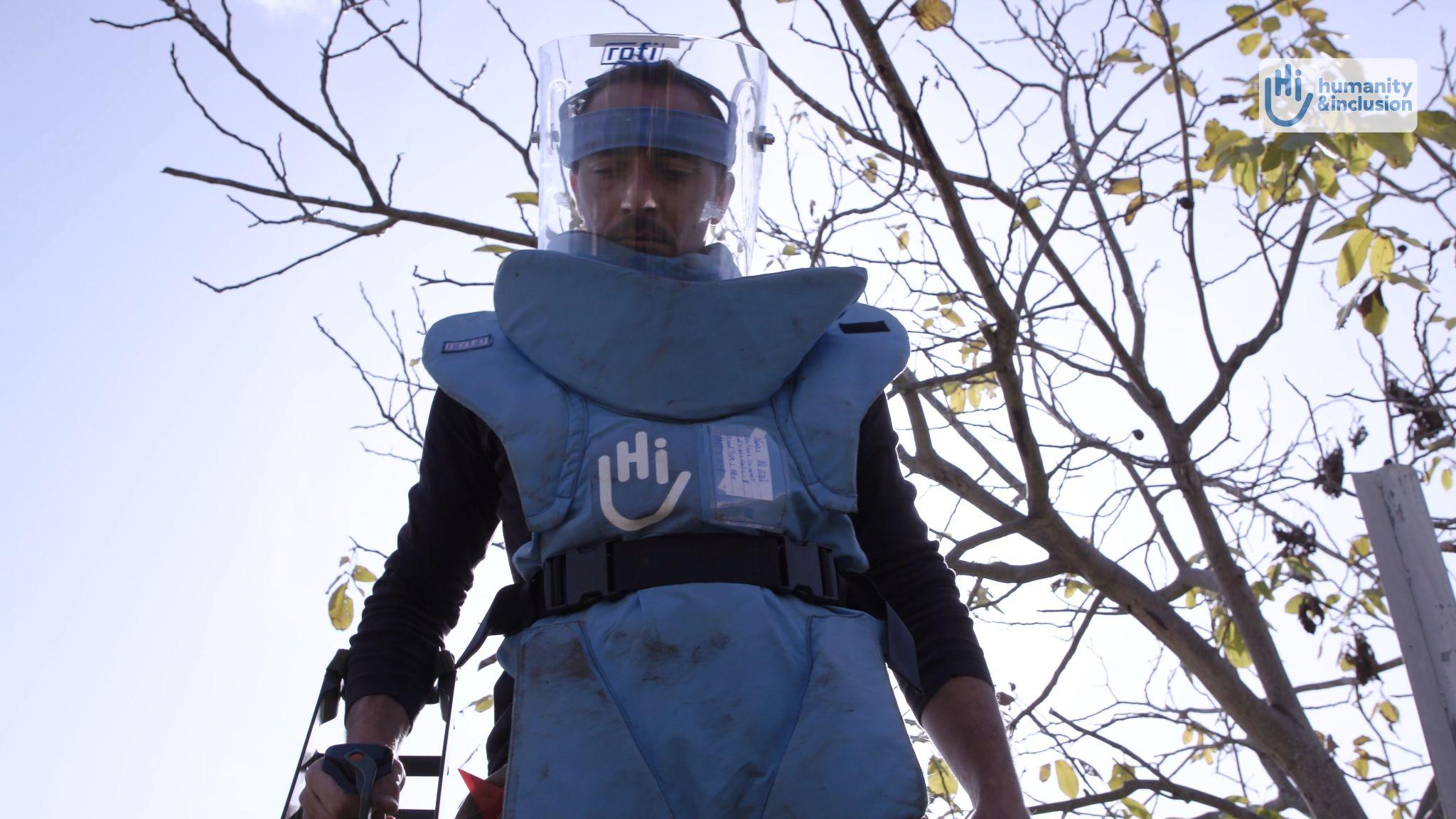
Some subjects resist the camera. Mine clearance is one of them. The work is methodical and slow by design, because the alternative to slow is fatal, and the danger that justifies the whole operation never appears in any frame you can safely shoot. A deminer kneeling in a marked lane, moving a few centimetres at a time, looks calm. That calm is the point, and it is also the problem for a filmmaker.
In 2022 Humanity & Inclusion, the organisation formerly known as Handicap International, needed a record of its demining work in Lebanon. This is how we filmed it, what else came out of the same shoot, and why the choices we made are the ones we would make again on any documentary in Lebanon.
The client and the ground
Humanity & Inclusion has been clearing mines in Lebanon since 2011. By the end of its first ten years in the north of the country it had cleared almost one million square metres of land and found 6,132 explosive items, among them 5,615 landmines, 22 anti-tank mines and 495 items of unexploded ordnance, with around 35,000 people benefiting from the released land (HI, December 2021). The same announcement set out the next chapter: clearance operations in the Aley district of Mount Lebanon, starting in January 2022.
That is where we filmed. Teams were clearing contaminated land in the Aley area while we were on site, and the commission was a full visual narrative of those field operations: a documentary, technical infographics that explain the clearance process, and a professional photography series, so the client had material that worked in reports and print as well as on screen.
The approach: film the procedure at its own pace
The temptation with slow work is to speed it up in the edit, to cut around the waiting and make it look like action. We did the opposite. We treated the process itself as the subject and filmed the procedure at the pace it is actually done. If the audience feels the patience, they understand the discipline, and the discipline is the story.
Two other elements carry what the field footage cannot:
- Interviews at the Lebanese Mine Action Centre, which put the clearance work inside the national programme that directs it. A viewer needs to know this is not one team in one field. It is a country working through a map.
- Testimony from people who had been injured by mines. These supply the stakes. Without them a demining film is a procedural, and the reason the procedure exists never appears on screen.
Together, the three layers do what none of them could do alone: the field footage shows how, the Mine Action Centre shows why here, and the survivors show why at all.
One shoot, three deliverables
The documentary runs three minutes and twenty-nine seconds. But the commission was never only a film.
The photography was shot alongside the filming, not after it, by a photographer working next to the camera team while the deminers worked. It was delivered to stand on its own, for the client's reports and print material. This is usually the better argument for shooting stills alongside video rather than booking them separately: the light, the access and the moment are the same, and the client pays for one field day instead of two.
The infographics explain the clearance process step by step, the part of the work that live footage can show but cannot label. A technical drawing of a clearance lane does what a wide shot of a hillside cannot.
The film, the stills and the diagrams were planned as one package before anyone drove to Aley, which is what made the field days efficient in a place where nothing else can be rushed.
Working safely on contaminated ground
Filming next to active clearance means the crew follows the deminers' rules, not its own. Marked lanes, cleared paths, the site supervisor's word on where a tripod can go. A small crew helps here. Fewer people means fewer positions to clear and less to manage while a team is working a few metres away. The camera adapts to the site, never the other way round.
That constraint shaped the look of the film. Long lenses from cleared ground, static frames that let the procedure play out, and no drone over an active site. It is quieter than a typical documentary, and it is honest about where the camera was allowed to stand.
What this project shows
Demining is the clearest case we have for a principle that runs through all our humanitarian and impact films: the dramatic version of a story is usually the less truthful one. The film made its case, a Lebanon free of mines, to people who will never stand on contaminated ground, by showing them what standing there actually involves.
It also shows what a single field commission can produce when the film, the photography and the explanatory graphics are planned together: three sets of material, one crew, one trip into the mountains.
See the Humanitarian Demining film page for the documentary, and the documentaries page for the rest of our long-form work.
Talk to us
If your organisation needs its field work documented in Lebanon, on film, in photographs or both, tell us where the work happens and we will tell you what it takes to film it properly.