Plenty of production companies will offer to make you a podcast. Fewer can show you their own. We produce two: Kelmeh Wehdeh, a podcast about how we communicate, now at three seasons and 19 episodes and counting, and ArtLine, a long-form conversation series with Lebanese artists that ran for 21 episodes across two seasons. Both are produced, shot and cut entirely in-house in Beirut.
That makes this article a first-hand account. Here is what actually goes into producing a podcast in Lebanon, decision by decision.
The region is listening
Podcasts are not a niche habit in MENA. Spotify's regional team, in research reported by Campaign Middle East in 2023 and based on a YouGov study, described the MENA markets as having the highest proportion of heavy podcast listeners anywhere, with Saudi Arabia leading at 67 per cent of adults listening to an hour or more of podcasts a week. The same piece reported podcast streaming on Spotify in MENA growing by over 190 per cent year-over-year in 2022, and a clear regional appetite for long-form interviews and conversations.
That long-form point matters for anyone planning a show here: the format that works is not radio snippets, it is real conversations with room to breathe, exactly the format both of our shows use.
Decision one: what is the show actually about?
A podcast is a format that repeats, so the concept has to survive repetition. Kelmeh Wehdeh works because its subject is bottomless: how we communicate, with words, without words, with tone, with looks, with silence, explored with guests from every walk of life. ArtLine works on a different repeatable unit: one artist, one practice, one honest conversation per episode, with painters, calligraphers, musicians and makers.
Notice what both concepts have in common: neither depends on news, trends or a marketing calendar. That is what lets a show accumulate seasons instead of stalling after four episodes, which is the fate of most branded podcasts that begin without a repeatable idea.
Decision two: audio, video or both
In practice, a modern podcast in this region is a video production. The full episodes live on YouTube alongside audio platforms, and short vertical clips carry the show to people who will never press play on a full episode. Kelmeh Wehdeh runs this way: full episodes plus a steady stream of short clips from each conversation.
This decision shapes everything downstream: a video podcast needs a set that can hold for a full season, lighting, multiple angles for the edit, and clean sound as the non-negotiable foundation. Which leads to the next decision.
Decision three: where you record
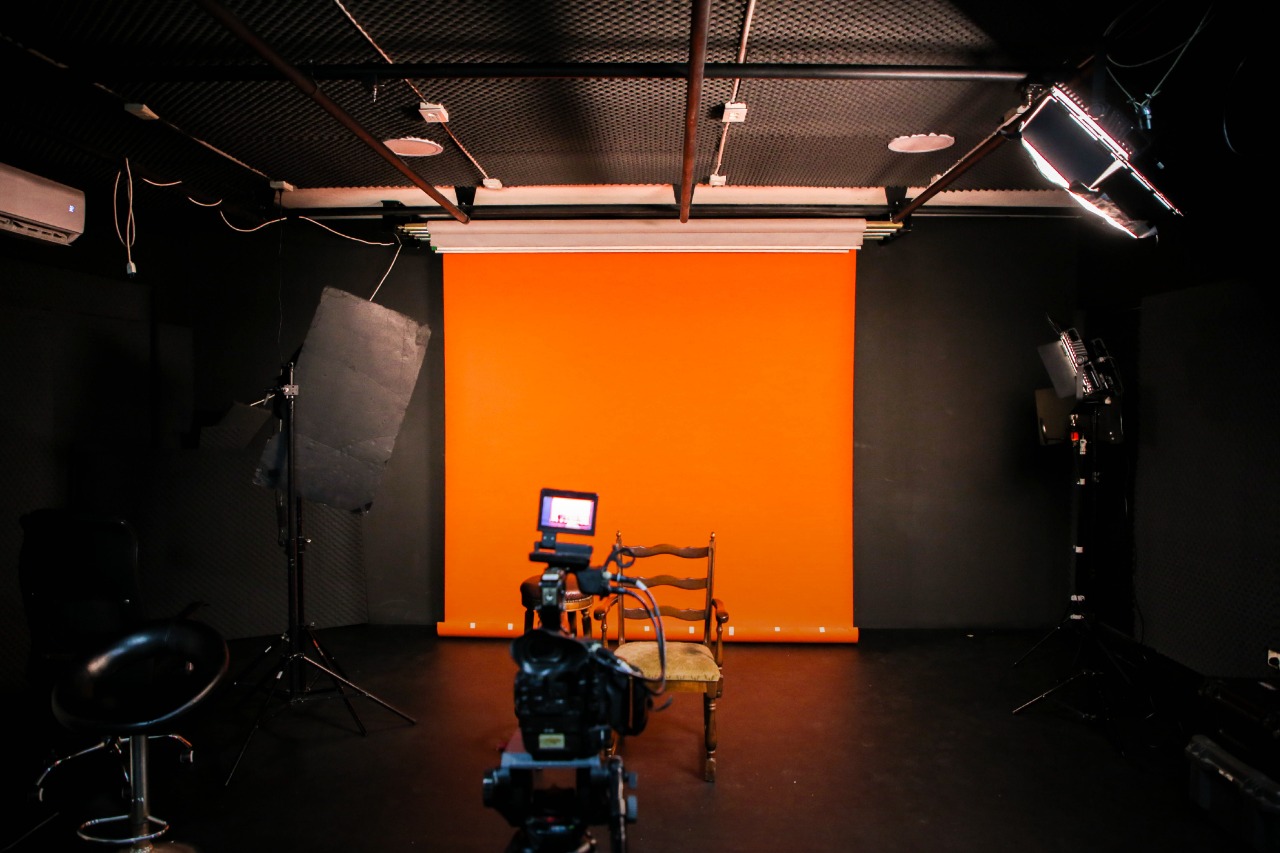
Consistency is the quiet requirement of a podcast: the audience should land in the same world every episode. That is much easier when the show has a home. We record in our own studio in Hamra, a fully equipped space with professional lighting and sound, and it is the same studio we shoot our productions in. You can see the space itself in the Fine Line Studio film.
If you are starting a show without a production company behind you, that studio is also available to rent, with the lighting, sound and flexible setup already in place, which for most independent podcasters is far cheaper than building a corner of their office into a set that still sounds like an office.
Decision four: the production rhythm
A season of a podcast is a logistics exercise: guests booked, episodes recorded, edited, delivered and published on a cadence the audience can rely on. In-house production is what makes our two shows sustainable; recording, edit and delivery run through the same team and pipeline as the rest of our work, so a season is planned like any production, not improvised week to week.
For a branded show, this is the honest budget conversation: the real cost of a podcast is not episode one, it is episode twelve. Plan the season, not the pilot.
What Lebanon adds
A podcast produced here has something feeds full of studio-perfect global shows do not: place and language. Our shows move naturally through the way people in Lebanon actually speak, and the guests, artists, scouts, coaches and everyone in between, are people global shows will never reach. In a region hungry for local long-form conversation, that is the advantage.
Starting one
Whether you want a show produced for your organization or a studio to record your own, the decisions above are the brief: concept that repeats, video from day one, a consistent home, and a season-long plan. Hear the results on our podcasts page, then talk to us. Email info@finelineprod.com, call +961 1 741 744, or use the contact page.